Ed Sheeran
Introduction
Ed Sheeran — the 35-year-old English singer-songwriter behind “Shape of You” and one of the world’s best-selling artists — is facing an unusual form of professional backlash: an Irish radio station has removed his entire catalog from its playlist for the foreseeable future, pro-Palestine groups announced a protest outside his Philadelphia stadium show, and four of his tour’s supporting acts quit the bill. The trigger was not anything Sheeran said or did on stage, but a decision he insists was not his: the removal of rapper Macklemore from Sheeran’s US Loop Tour after Macklemore’s pro-Palestine stage comments at MetLife Stadium. Sheeran says the call was made by the tour’s promoter and the venues and that he spent a week trying to reverse it; his critics, including some of his own opening acts, have treated his neutrality as complicity. At the September 19 Philadelphia show — the first after the walkouts — Sheeran broke his silence on stage, wept, and called Israel’s actions in Gaza “unjustifiable,” an intervention that has both answered his critics and reignited the fight over how he handled the removal.
Background Information
Sheeran rose from busking in Ipswich to global stadium-filling fame on albums like “×” and “÷.” His 2026 Loop Tour of US stadiums has carried him through the season with a rotating roster of opening acts, among them the Irish singer-songwriter Aaron Rowe and the Irish folk band Beoga. One of the tour’s openers was Macklemore, the Seattle rapper, whose sets on the tour’s opening weekend at MetLife Stadium in East Rutherford, New Jersey, on September 4 and 5, repeatedly called for a “Free Palestine” and performed his protest song “Hind’s Hall.” Classic Hits Radio, the Dublin station now at the center of the story, is run by Bay Broadcasting, an independent Irish-owned broadcaster whose playlist had long featured Sheeran’s music.
The Controversy or Incident That Led to Their Cancellation
Allegations. The claims in this section are allegations and counter-claims from Macklemore’s public statements and from protest groups organizing against the tour, as reported by the NY Post. They were never admitted by Ed Sheeran, never criminally charged, and never adjudicated in court. Sheeran denies making the decision to remove Macklemore and says the venues and promoter made it, after warning they would pull his shows, and that he tried for a week to negotiate a compromise.
Macklemore was dropped as an opening act on Sheeran’s Loop Tour after his MetLife performances. Macklemore alleged that New England Patriots owner Robert Kraft pressured Sheeran into dropping him — telling the singer he would not be allowed to perform at Gillette Stadium and encouraging other stadium owners to issue a similar ultimatum; that account of pressure has not been tested in any court. Following the removal, four other supporting acts quit the tour in protest: the Irish acts Aaron Rowe and Beoga, along with Lukas Graham and Finneas.
Sheeran addressed the controversy on Instagram, writing, “I am not complicit. I have my personal views on this devastating conflict. Just because I choose not to speak publicly, it doesn’t mean I don’t have them, and it doesn’t mean I don’t care.” He said venues on the upcoming dates “communicated that they would pull the shows if he was still supporting,” based on how Macklemore conveyed part of his message rather than everything said; that he spoke with venues all week, including Kraft, and engaged with promoters and activists on both sides; and that the venue and promoter decision “was final,” noting Macklemore’s tour contract was with the promoter, not with him.
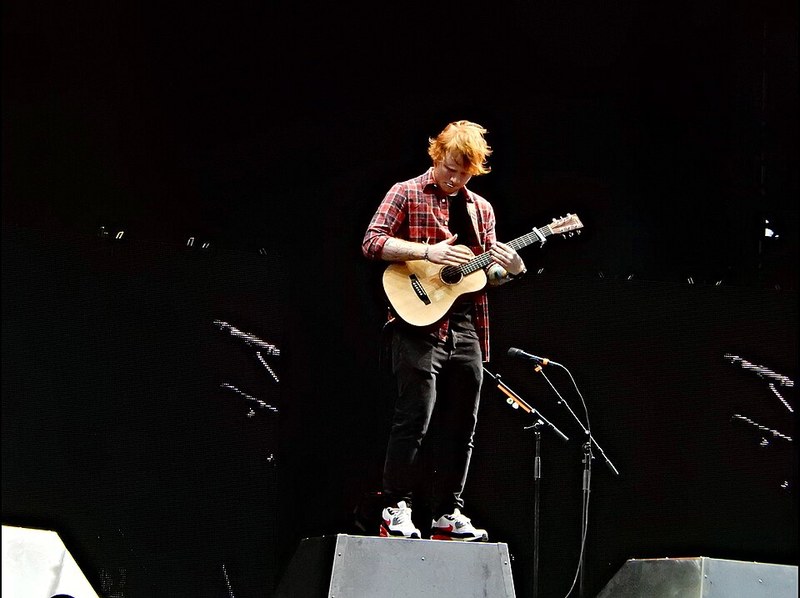
At the Philadelphia show on September 19, 2026, Sheeran dropped the public silence he had defended on Instagram. Just after the concert was scheduled to begin, he told the crowd, “I’ve had to take and make difficult decisions and I am making mistakes, and I am so, so sorry,” adding that he had never wanted to disappoint fans or be an “activist musician.” He said he had been thrust into the middle of “important and passionate argument about freedom of speech and the most complex political issue on the planet,” and that “this is a humanitarian issue. I cannot hide how I feel about it anymore.”
He acknowledged the Hamas-led October 7, 2023 attacks on Israel as “horrific” and something that “compounded centuries of Jewish pain,” then said “what is happening in Gaza is catastrophic and unjustifiable and disproportionate,” that his heart had been “broken by the scale of devastation” and the loss of civilians and children, and that “the systemic injustice we’re seeing unfolding [in] the West Bank cannot be overlooked.” Reports described him weeping on stage as he spoke, with the crowd responding in applause; he told the audience the concert should remain “a place where everyone is welcome,” where people with opposing views could still “agree on singing these songs.” The speech did not end the criticism: activists outside the stadium characterized the tour’s treatment of Macklemore as censorship, and the intervention itself marked a notable shift from the Instagram statement days earlier, in which Sheeran had framed his shows as no place for politics at all.
Public Reaction and Consequences
On Thursday, September 17, effective that day, Classic Hits Radio announced it was removing Sheeran’s music from its playlist “for the foreseeable future” after considering feedback from its audience and the artists’ withdrawals. Dave Kelly, the station group’s program director, said the move “has been carefully considered,” was “not intended as a personal judgment on Ed Sheeran,” and that the station stood “alongside Irish artists who have made what is undoubtedly a significant professional decision based on their own convictions.” “In light of the strength of feeling expressed by our listeners,” Kelly said, removing the music was “the appropriate decision for Classic Hits Radio at this time.” The station said it acknowledged Sheeran’s own explanation, recognized “differing and strongly held views,” and would keep the move under review. The pro-Palestine groups Philly Palestine Coalition and Shut Down D&Z announced a protest for September 19 outside Sheeran’s concert at Lincoln Financial Field, publicizing it with a flyer reading “Gaza is our compass” and “Billionaires, Zionists & Warmongers out of Philly.”
The protest went ahead as planned on the 19th: dozens of activists carrying Palestinian flags and signs reading “Gaza: Aid In Soldiers Out” gathered near the stadium’s SEPTA station, calling Macklemore’s removal an act of censorship, with Philadelphia police monitoring and a Civil Affairs Unit on hand. Philadelphia’s Jewish Voice for Peace said the performer exodus, demonstrations outside the stadium, and “plummeting resale ticket values” showed that “support for Palestinian liberation is growing daily.” The commercial pressure was visible in the resale market: hours before the 8 p.m. start, tickets were reselling on Ticketmaster for as low as $32.25, down from a $66.30 minimum earlier that day. The September 19 bill also shrank to Sheeran alone — as of that morning, Ticketmaster listed no other performers joining him on the Loop Tour date, after the withdrawals of the supporting acts.
Current Status
The Loop Tour has continued past Philadelphia, but as of the September 19–20, 2026 coverage: Sheeran’s music remains off the Classic Hits playlist, with the station describing the removal as “foreseeable future” and under ongoing review rather than permanent. The tour proceeds with a stripped-down bill after the walkouts — no supporting acts were listed on the Philadelphia date. Sheeran, having broken his stage silence, has positioned himself between the two camps: apologizing to fans for “mistakes,” while refusing to disavow either his criticism of Israel’s conduct in Gaza or the removal decision he says was made over his head by venues and the promoter.
Impact on Their Career/Life
The episode has made Sheeran a rare case of a superstar absorbing cancellation-style consequences without a personal scandal: a nationwide radio ban in a market that has long embraced him, a third of his tour’s undercard gone, protests greeting the tour’s next stop, and resale prices for the Philadelphia show sinking to around $32 as the controversy peaked. His defense — that he chose “to be a place of safety and sanctuary, to maintain diplomacy and keep conversations open” rather than “shouting the loudest” — drew both criticism and acknowledgment, with even the station that banned him crediting his explanation while dropping his records anyway. The on-stage speech recast that position: the deliberately apolitical superstar publicly took a side on the world’s most polarizing conflict, apologized for “mistakes,” and wept in front of his fans — a spectacle that satisfies some critics while giving new ammunition to others, and one whose commercial and reputational cost, alongside whether the remaining tour dates proceed without further walkouts, will determine if this stays a one-market protest or becomes a broader professional cost.