Macklemore
Introduction
Macklemore — the stage name of Benjamin Hammond Haggerty, an American rapper from Seattle, Washington — is a Grammy-winning artist best known for the early-2010s hits “Thrift Shop,” “Can’t Hold Us,” and “Same Love,” recorded with producer Ryan Lewis. In September 2026 he was dropped from the remaining U.S. dates of Ed Sheeran’s Loop Tour after using his opening slots at MetLife Stadium to deliver a pro-Palestinian speech, lead a stadium-wide “Free Palestine” chant, and perform his 2024 protest song “Hind’s Hall.” Within days, the Israeli-American Council had launched a petition demanding Sheeran drop him; a week later the promoter confirmed he was off the bill after venues refused to host shows with him on the lineup.
Background Information
Haggerty was born and raised in Seattle and began releasing music independently in 2000 before rising to international fame as half of Macklemore & Ryan Lewis between 2009 and 2016. Their 2012 album “The Heist” produced multiple international chart-toppers, and “Same Love” established his early reputation for folding social and political themes into pop-rap, in his case LGBTQ+ rights. In 2024 he released “Hind’s Hall,” a protest song named for the building occupied by pro-Palestinian demonstrators at Columbia University, which has since become closely associated with his support for Palestinians. That history made his booking as an opener contentious before he ever took the stage: Rabbi Menachem Creditor, father of one concertgoer, later said it was a mistake for Sheeran’s team to book him at all “given the rapper’s past anti-Israel remarks.”
The Controversy or Incident That Led to Their Cancellation
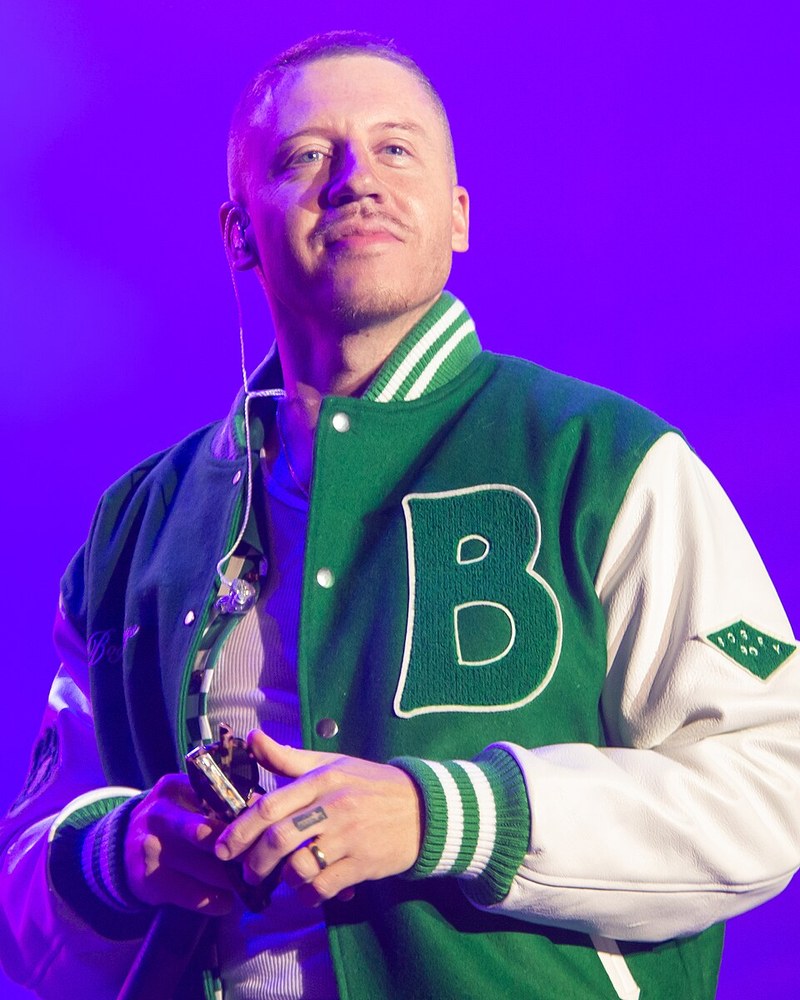
On Friday, September 4, 2026, Macklemore opened for Ed Sheeran at MetLife Stadium in East Rutherford, New Jersey, before a crowd in excess of 80,000, wearing a keffiyeh draped over his shoulders. “A big part of the reason why I wanted to do this tour in the first place is so I could stand up in stadiums like this and say two words that are very near and dear to my heart: Free Palestine,” he told the crowd, adding that he wanted people “all the way in Gaza to the occupied West Bank” to know “that we have not forgotten about them.” During “Hind’s Hall,” footage from Gaza and pro-Palestinian demonstrations played on the stadium screens, and he accused Israel of committing genocide in Gaza — a characterization the Israeli-American Council would later describe as a “disputed claim[] presented to a massive audience as fact, without context or complexity.” He also tied the moment to a personal note about his 11-year-old daughter, and extended the chant: “I say, free Palestine! I say, free America, free Cuba to the Congo to Sudan to Iran, and all the people in America who have to live in fear because of this terrorist organization ICE.” He repeated the performance at the second MetLife show on Saturday, September 5.
Public Reaction and Consequences
The response was immediate, polarized, and — a week later — decisive. Concertgoer Moshe Creditor, 21, said: “Imagine my shock when he got 80,000 people to chant ‘Free Palestine’ while putting on a song and music video to go with it.” On Sunday, September 6, the Israeli-American Council launched a petition demanding Sheeran drop Macklemore, saying: “This was an Ed Sheeran concert – not a political rally, not a protest, and not an activist event.” The singer Pink drew a second wave of headlines after reposting a call for the rapper to be dropped. On September 14, Messina Touring Group, promoter of the tour’s U.S. leg, confirmed the removal in a statement to Rolling Stone: “We have been notified by venues on the upcoming U.S. tour dates that they will not allow a concert to take place with Macklemore on the lineup, which would result in the cancellation of the tour and impact hundreds of thousands of fans. After discussions with stakeholders, Macklemore will not be performing on the remaining support dates.” Macklemore had been slated for eight of the 10 remaining U.S. shows, including Kraft’s Gillette Stadium and venues in Philadelphia, Atlanta, Indianapolis, Charlotte, Arlington, and Tampa. Kraft confirmed he had barred the rapper from Gillette Stadium, citing the MetLife comments and “a broader history of rhetoric and imagery that we believe has been deeply offensive and hurtful to the Jewish community,” while saying the decision was “not about diminishing the suffering of innocent Palestinians.”
Current Status
Macklemore is off the Loop Tour’s remaining U.S. dates, which resume September 19 in Philadelphia without him, and he has responded with a roughly 1,000-word Instagram statement standing by his comments. In it, he claimed — and Kraft’s own statement effectively confirmed — that Kraft told Sheeran the rapper would “not be allowed” at Gillette Stadium and “had rallied some of the other stadium owners,” who allegedly gave Sheeran an ultimatum: “if Macklemore stays on the tour, you will not be allowed to play in our venues.” He wrote that he and Sheeran had a “painful disagreement,” saying Sheeran told him the words “Free Palestine” and the image of the Palestinian flag “were hurtful to a lot of people he spoke with” — while arguing his own remarks were nothing new: “What I said at MetLife I have been saying on stages around the world for almost three years.” “If those words cost me the stage, while turning the conversation back to Palestine, then it was the most successful tour I’ve ever been on,” he concluded. Kraft, for his part, said the show spread “divisiveness and hate” but extended an olive branch: “I would welcome the opportunity to sit down with Macklemore and discuss the facts, because ultimately our goal is the same – peace for all people, an end to suffering, and an end to all hate.” Rolling Stone noted that most of the objecting venues are government-owned, “potentially raising First Amendment issues if the venues barred Macklemore over his statements,” and reps for Sheeran and most venues did not respond to requests for comment. No sponsor or label action has been reported.
Impact on Their Career/Life
The firing is the most concrete professional consequence of Macklemore’s career-long fusion of music and activism: he lost eight stadium-opening slots on the biggest tour available to him after turning those stages into the largest platform his pro-Palestine message has had in years. He has framed the trade as worthwhile, while Kraft’s olive branch leaves the dispute partly unresolved in public. It also sets a precedent for touring artists: a venue-coalition pressure campaign, catalyzed by a single opener’s politics, proved capable of reshaping a headliner’s lineup.